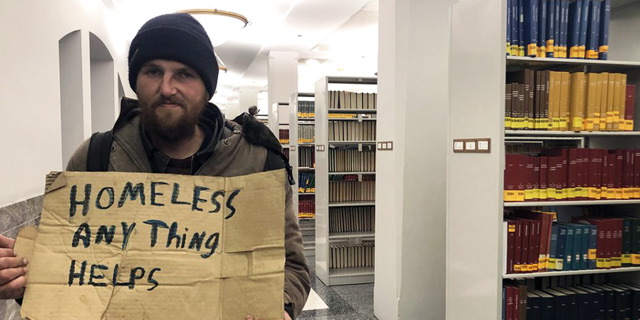
Some may ask “why do the homeless need the library?” The library offers many things, both tangible and intangible. The physical building itself provides shelter from extreme temperatures. It is a place to rest their weary minds and bodies. A place to utilize restroom facilities. Then of course, there’s the standard library services, circulation, computers, and various other resources offered by the public library. It’s also a place where library staff can offer a kind smile and assistance to those in need. This might very well be the only place that a homeless individual will be treated with kindness and respect.
The fundamental mission of libraries is to offer free and open access to all individuals regardless of a permanent residence or no address at all. Of course, that is a little tricky when libraries require identification and address information to obtain a library card. Most organizations require online applications to be completed before rendering services. For a homeless individual, the library may be the only place to access a computer. Many libraries offer courtesy cards to allow the homeless to gain access to library services. Utilizing library services should not be contingent upon having a library card.
Many libraries offer services needed to improve the situation of the homeless. Those needs vary for those individuals depending on whether they are chronically or situationally homeless. Public libraries have computers available with free internet access. With assistance from library staff or bringing in specific organizations, the homeless patron can complete online applications for employment, food stamps as well as search for location of temporary shelters, food pantry, legal and/or medical services, and much more. Several public libraries in large cities such as Nashville, Chicago, San Francisco have expanded their library services and resources by hiring social workers, HASAs (health and safety advocates), and offer medical services on a regular basis. Organizations can utilize meeting rooms to hold support groups and trainings to assist those that are seeking help.
Local city governments should seek out information from their local public libraries regarding the needs of the homeless population. Gathering information from local school districts, shelters and food pantries can provide valuable insight into the size of the homeless population as well as to what services are needed. With collaboration and training, libraries can offer services beyond the basic library services. The San Francisco Public Library reported problems with the lack of bathing for their homeless. The library staff partnered with a nonprofit, Lava Mae, that brought mobile showers to the library. A city bus was converted to house mobile. They also provide the soap, shampoo and towels. (Ruhlmann, 43) Many other city libraries have brought in similar services.
Of course, one of the biggest issues facing libraries is making sure all patrons are comfortable in the library. To some, the homeless are frightening. Many have the misconception that the homeless are all dangerous and lazy. How do you change the narrative? First start with the library staff by training and consistently implement library policies. Some public libraries require staff to watch Ryan Dowd's "A Librarian's Guide to Homelessness". The YouTube video is a great resource on how to be sensitive to homeless patrons. Another approach is to educate your patrons through community outreach and modeling behavior “treat them as you wish to be treated”. This is a complex undertaking with no one size fits all handbook on how to serve all of your patrons with or without a permanent address, but we must start somewhere. The homeless crisis has only grown and what better place to help them than the public library.
Works Cited:
Ruhlmann, Ellyn. "A Home to the Homeless: Libraries Offer Refuge and Support to Those in Need and Help Foster a New Community Approach to Homelessness.: American Libraries (Chicago, Ill.), vol. 45, no. 11-12, American Library Association, 2014. p. 40-.

No comments:
Post a Comment